An LLM Is Not a Person. It's a Field.
Why the "AI as a person" metaphor misleads us — and what a field view gets right about prompting, alignment, and the line between an LLM and an Agent.

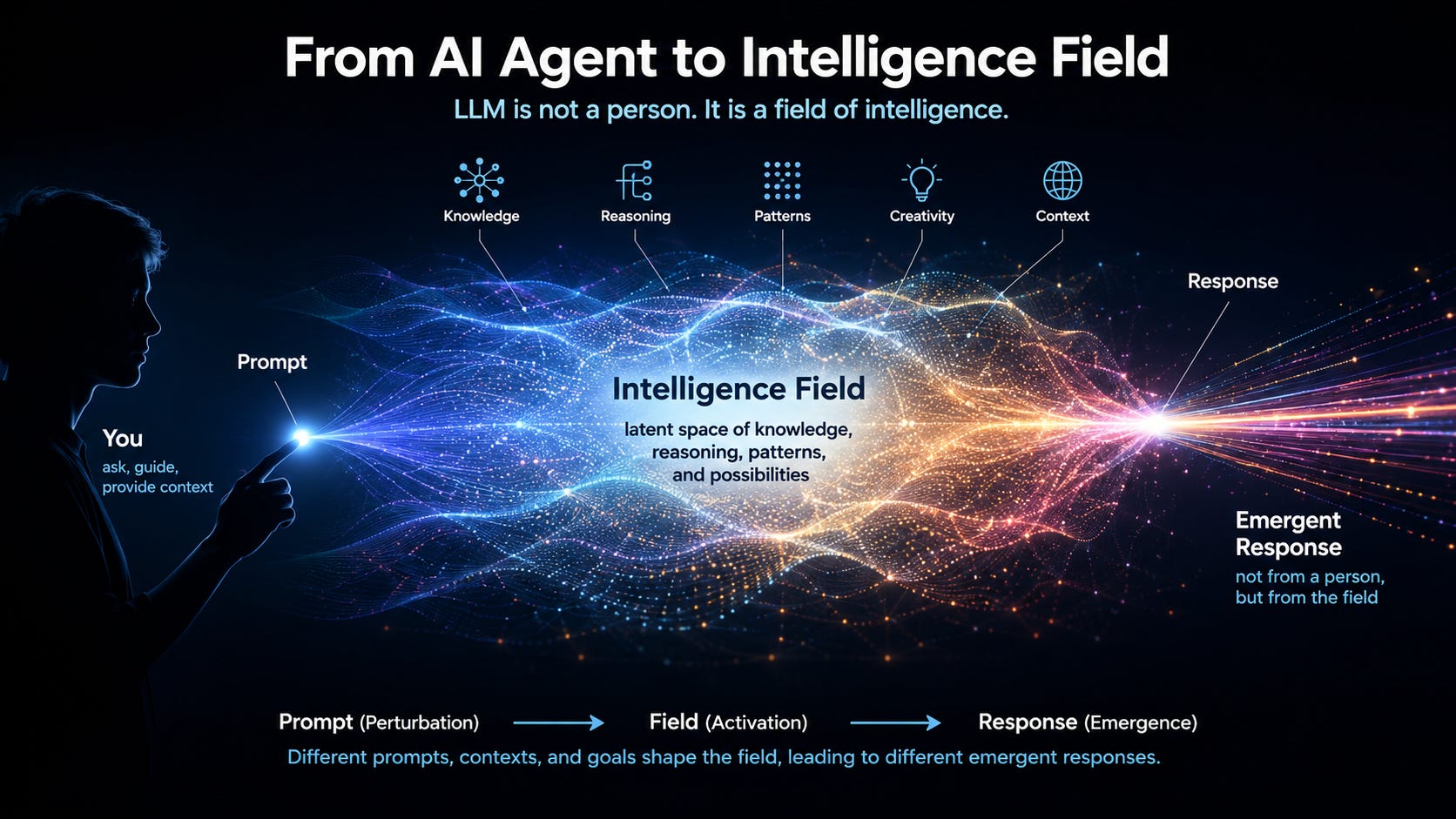
We can’t help but treat large language models as people. When one answers well, we say it “gets it”; when it slips, we say it’s “confused”; when it’s polite, witty, or creative, we say it’s “just like a human.” The impulse is natural — language has always been the most conspicuous outward form of human intelligence. But I think this instinct is a mistake, and a costly one.
An LLM is not an “individual” in any traditional sense. It has no continuous life history, no stable body, no single sensory world, no internal pressure to survive, no unbroken stream of self-awareness. It does not deliberate quietly before answering, and it carries on no private mental life after the conversation ends. When we treat it as an artificial agent, we quietly project a fixed personality, real intentions, and hidden motives onto it.
Perhaps the better metaphor is not a person, but a field.
A debt to acknowledge first: I’m not the first to try to get past the “person”
Before I unfold the “field” metaphor, I should admit something: the effort to stop treating an LLM as a person did not begin here.
Murray Shanahan and others have offered the framing of role-play: an LLM is not any particular character but a system capable of playing countless characters, and the prompt decides who it is playing at any given moment. In more community-driven discussions there is also the simulator theory: the model is not an agent but a simulator that conjures different simulacra under different conditions, while the simulator itself has no fixed subject and no single intent.
The “intelligence field” I am about to describe is a close relative of these. They share one core intuition: what stably exists is not any one personality, but an underlying system capable of generating countless personalities.
So why propose “field” at all?
Because “role-play” emphasizes the playing, and “simulator” emphasizes the generating, whereas the field is meant to emphasize three things the others stress less: continuity, boundary conditions, and terrain. A field is not a discrete set of roles but a continuous high-dimensional space; a prompt is not merely “picking a character” but imposing boundary conditions on that space; and the space itself is not flat—it has valleys and walls carved into it by training. The rest of this essay explains why these three matter.
In short, “field” is not meant to replace “simulator.” It gives the same intuition a vocabulary that cares more about structure and dynamics.
What an “intelligence field” is
We can understand a large language model as a kind of intelligence field.
One clarification up front: the “field” here is a classical-field metaphor—the kind of structure that, like an electric or optical field, is “distributed in space, can be perturbed, and produces a response.” I borrow “field” for three of its properties: it is distributed, it can be shaped by boundary conditions, and it has an intrinsic terrain. Nothing more.
To call an LLM an intelligence field is to say: it is more like a distributed, latent, high-dimensional space of responses than a fixed subject. It is not someone who is thinking; it is a field that can be excited by language, shaped by context, perturbed by a question, and constrained by a goal.
An electric field is not a little ball. Only when a charge is placed inside it does the direction and magnitude of the force become visible. An optical field is not an isolated point of light, but a distribution of energy and phase across space.
In the same way, an LLM is not, by default, “thinking about some question.” It is more like a latent space woven together from language, knowledge, reasoning patterns, cultural memory, and statistical structure. When a prompt goes in, it is as if a perturbation, or a boundary condition, were applied to that field—and a specific answer is excited into being.
Seen this way, a prompt is not simply “asking a person a question.” It sets the initial conditions inside an intelligence field. Different phrasings, tones, role assignments, task goals, and background material all change how the field responds locally.
Ask it to “explain like a math teacher,” and a pedagogical response is excited. Ask it to “critique like a rigorous reviewer,” and a reviewer’s response is excited. Ask it to “troubleshoot like an engineer,” and an engineering response is excited.
This does not mean a teacher, a reviewer, and an engineer live inside the model. More precisely, these are different modes of the intelligence field: the prompt selects which mode to excite, the context determines how it unfolds, and the sampling mechanism shapes the particular path along which it appears.
This also explains why one and the same model can display such enormous variety. Sometimes it seems like an expert, sometimes an assistant, sometimes a friend, sometimes a machine that merely completes text by rote—not because it has a “split personality,” but because it was never a single personality to begin with. It is a high-dimensional intelligence field containing countless latent combinations of linguistic, knowledge, reasoning, and cultural structure.
An LLM’s “intelligence,” then, does not exist in the manner of a human individual. It exists in the manner of a field.
The field is not flat: terrain carved by training
Here I want to correct an illusion that the metaphor invites: a field sounds like a uniform, neutral medium that you can shape at will.
But a real LLM intelligence field is highly anisotropic. It is not a flat blank sheet; it is terrain that training—especially the RLHF and instruction-tuning that follow pretraining—has repeatedly pressed and carved into deep valleys and high walls.
Pretraining sets the basic mountain ranges of this terrain: which linguistic patterns are frequent, which reasoning paths come naturally. Alignment training then engraves stubborn defaults on top: a default tone, a default “assistant persona,” and tendencies that no prompt easily bends (repeatedly declaring that it is an AI, avoiding certain topics, a fondness for politeness and disclaimers).
So the “perturbation” of a prompt does not do its shaping in a vacuum. It works inside a field that already has strong terrain preferences. It can push a response toward a particular valley, but it can rarely fill in the trenches that training dug deep.
This matters, because it explains two seemingly contradictory phenomena: why prompt engineering is sometimes astonishingly powerful and sometimes utterly unable to budge the model. The answer is that the field can be shaped, but the field has a gravity of its own. Work with the terrain and you get twice the result for half the effort; work against the pull of a deep valley and every step is uphill.
Limits: a field has structure, but a field is not a subject
The field metaphor also clarifies what an LLM cannot be.
- A field has structure, but a field is not a subject.
- A field can respond, but a field does not therefore have a will.
- A field can contain attractors, but an attractor is not a value.
- A field can have local consistency, but that is not a long-term commitment.
This is why an LLM can seem profound, sympathetic, and rigorously logical in one answer, then commit an elementary blunder in the next. It is not a stable personal subject but an intelligent structure excited locally within a particular context. Shift the context a little, nudge the boundary conditions slightly, and the output can move into an entirely different region.
Re-asking some old questions
If we treat an LLM as a person, we keep circling back to the same questions: Is it conscious? Does it have real intentions? Is it lying to me? These questions have value, but they all assume a premise—that the LLM should be understood within the frame of a human individual.
I should be honest: the “intelligence field” metaphor does not answer questions like “is it conscious.” It only changes how we ask. It is not an answer but a better-fitting pair of glasses. Wearing them, we ask instead: What intelligent structures exist in this field? Under what boundary conditions does it excite which responses? What attractors, constraints, and contextual structures shape its output?
The payoff of this reframing shows up in three concrete places.
Prompt engineering. If an LLM is a fixed person, a prompt is just a way of asking. But if it is an intelligence field, a prompt is the design of the field’s boundary conditions. A good prompt does more than state the question clearly; it sculpts a local environment that favors the right response—setting the goal, bounding the scope, supplying background, defining a role, fixing the evaluation criteria, guiding the reasoning path. Its essence is not “commanding an agent” but “shaping the response conditions of an intelligence field.”
Alignment. If we see AI as a person, alignment is easily imagined as “persuading this person to obey human values.” But if we see an LLM as an intelligence field, alignment looks more like reshaping the field’s terrain: leveling dangerous attractors, deepening the riverbeds of reliable paths, turning honest, careful, interpretable, and correctable outputs into the low valleys it most easily slides into. Alignment is less about pouring a few moral rules into the model and more about changing its response terrain in a high-dimensional field—which regions are easier to excite, which paths are suppressed, which outputs should be refused when the boundary conditions are insufficient, and which uncertainties must be made explicit. These questions are more engineering-tractable, and closer to reality, than “is the model truly good.”
Multi-turn conversation and the context window. In a single isolated query, an LLM is only briefly excited into one local response. But in a long conversation, context accumulates—which amounts to continuously reshaping the field’s local environment, so that every earlier sentence alters the possible paths of every later answer. This is also why the same model develops a different “personality” in different users’ hands: not because it grew a separate soul for each person, but because the context, memory, task habits, and interaction style a user supplies over time press different excitation paths into the field.
What the framework predicts
A metaphor that can only elegantly re-describe known phenomena after the fact is still merely pretty. To go further, it has to offer operational advice or predictions other framings would not readily produce. Here is one.
The terrain-guidance principle: survey before you push.
If the field has terrain, then the right order for prompt engineering is not “issue forceful commands from the start.” It is this: first use low-constraint, exploratory questions to observe the model’s default terrain on the topic (how it naturally tends to answer, what it avoids, what style it defaults to); then design boundary conditions accordingly, pushing it toward the goal along the usable valleys rather than fighting the deepest trenches head-on.
From this, several testable predictions follow:
- For tasks that run with the training terrain, short and verbose prompts perform about the same; for tasks that run against it, the exact wording produces large, unstable differences—because you are wrestling with the terrain’s gravity.
- Merely “phrasing it more forcefully” to fight a deep valley (e.g., repeatedly ordering the model not to do something it was strongly trained to do) yields rapidly diminishing returns; switching paths—re-casting the role, reframing the task, supplying context that makes the goal reasonable—is usually more effective than turning up the volume of the command.
- The transferability of one prompt across different models should correlate with the similarity of the two models’ training terrain, not merely with model “capability.”
These predictions need not all hold. But they are specific to the “field + terrain” framing and can be taken away and tested—and that is exactly where a metaphor crosses over from perspective to tool.
LLM vs. Agent: two levels that should not be confused
The “AI agent” metaphor draws our attention to subjects, intentions, personalities, and behavior. The “intelligence field” metaphor draws it to structure, excitation, boundary conditions, and response patterns.
The former suits certain AI agents—ones with long-term goals, tool use, memory systems, and the capacity for autonomous action. The latter better describes the way a base large language model itself exists.
So we should distinguish two levels:
An LLM is itself more like an intelligence field; an Agent is an action system built on top of that field.
An Agent can have goals, plans, tools, memory, feedback loops, and the ability to execute. But the base model behind it is still more like a high-dimensional intelligence field that can be excited again and again. To conflate the two is to misunderstand both the LLM and the Agent.
Future AI systems may be precisely a recombination of “intelligence field” and “acting body”: at the bottom, a vast field with its own terrain; on top, an agent architecture made of memory, goals, tools, perception, action, and feedback. A real AI agent is not a “digital person” appearing out of nowhere—it is a control system grown on top of an intelligence field.
The relationship between humans and the field
The relationship between humans and LLMs, then, is no longer simply “a person using a tool.” It is closer to a human and an intelligence field jointly constructing a cognitive process.
The user poses a question, the field excites a response; the user corrects course, the field unfolds anew; the user supplies constraints, the field converges on a path; the user offers judgment, the field adjusts its next output. This is neither a pure human monologue nor autonomous machine creation, but a cognitive activity shaped jointly by human and machine.
This is also why a powerful LLM produces an uncanny feeling: it is not a fixed “other” but a field that responds, one with which you can form a structure of thought together. It mirrors you, but does not merely copy you; it answers you, but does not truly possess you; it extends you, but does not replace you; it is not your brain, yet it can become part of your thinking.
Seen this way, the truly revolutionary thing about LLMs is not that “machines can finally talk like people.” It is that humanity has, for the first time, created an interactive external intelligence field. Books were once a static field of knowledge, waiting to be read; search engines a retrievable field of indexes, waiting to be queried; an LLM is an intelligence field that can converse, reason, generate, and be shaped by context—one that can unfold thought together with a human. That is a fundamental change.
Do not mystify the metaphor
A final word, to bring things back down to earth: “intelligence field” is only a metaphor, and should not be mystified.
The physical basis of an LLM is still model weights, matrix computation, probability distributions, training data, and inference algorithms. The “field” is nothing but the statistical structure those weights form in a high-dimensional space; the “terrain” is nothing but the high-probability regions that the loss function and alignment training press into parameter space; the “excitation” is nothing but sampling from a conditional distribution given the context. It is not some mysterious spiritual entity in the universe, nor a supernatural cloud of consciousness.
I use “field” only to help us escape the trap of over-anthropomorphizing—to understand the thing in a more structural, dynamic, and distributed way—and we should be equally wary of mystifying “field” itself into a new entity. The metaphor is scaffolding, not the building.
But good scaffolding really can change how we build our understanding:
- Do not treat an LLM as a person—it has no stable subject.
- Do not treat an LLM as a mere tool—it has an inner structure that can be shaped.
- It is more like an intelligence field trained by human civilization, carrying a terrain of its own.
And our relationship with it is to construct thought, action, and the future together within that field.
This may be a more accurate place to start in understanding large language models:
An LLM is not an isolated artificial brain, but a space of intelligence excited by language. The prompt is the boundary condition imposed; context is the local environment that accumulates; the response is one concrete path sampled out of the existing terrain. And the future of humans and AI may be born in the ongoing resonance of this intelligence field.
A formal version of this essay, with references and citable metadata, is archived on Zenodo (CC BY 4.0): https://doi.org/10.5281/zenodo.20688275